How Tolkien’s Tech Companies Are Turning the Baltics into Middle-earth 2.0
From Palantir and Anduril to Onodrim and Isengard, names associated with J.R.R. Tolkien’s Middle-earth are becoming increasingly visible in the Baltic defence ecosystem. Behind them are AI platforms, interceptor drones, missiles, production plans and agreements involving millions of euros.
Several of the technology companies becoming more visible in the Baltic defence sector share an unusual feature: names associated with J.R.R. Tolkien’s Middle-earth.
Palantir, Anduril, Onodrim Industries and, immediately south of the Baltic states, Isengard Industries are now linked to offices, military cooperation, procurement frameworks, technology integration or manufacturing in Lithuania, Latvia, Estonia and Poland.
Baltic Focus examined how this broader defence-tech naming trend is translating into a regional presence and, where information is public, what can already be said about the money involved.
The companies are not part of one corporate group, and the origins of their names are not documented equally. Palantir and Anduril have openly acknowledged their Tolkien references. Onodrim and Isengard use names taken directly from Tolkien’s vocabulary, although no public statements by their founders explaining the choice were found.
The more important connection is industrial. These companies work in data and artificial intelligence, autonomous systems, sensors, command-and-control software, drones, missiles and defence manufacturing. An increasing share of that activity now has a Baltic or nearby Polish footprint.
Palantir: Lithuania as the main Baltic foothold
Palantir takes its name from the palantíri, the seeing stones in Tolkien’s fiction. The reference has long been part of the company’s public identity and internal culture.
Lithuania is Palantir’s clearest Baltic base.
The company has operated there since 2022. In April 2023, Lithuania’s Ministry of National Defence announced a strategic partnership with Palantir and plans for a regional big-data competence and technical hub in Vilnius. The cooperation was linked to the development of digital defence solutions and to Lithuania’s ambition to strengthen data-based capabilities in the Baltic region and NATO.
The relationship continued to expand in 2026. On 23 September 2026, Lithuanian President Gitanas Nausėda met Palantir CEO Alex Karp in New York and said Lithuania could become a regional centre for the company serving the Baltic states and NATO’s eastern flank. According to the Lithuanian presidency, the existing team already serves clients across the Baltic region, while further expansion could include engineering, product deployment and business development.
Alongside defence cooperation, Palantir already has substantial civilian public-sector business in Lithuania.
In October 2024, Lithuania’s State Data Agency awarded Palantir Technologies Lithuania a contract for the Palantir Foundry platform. The contract award notice gives a value of €4.983 million excluding VAT for the licence and infrastructure agreement. Lithuanian procurement records also contain a larger €42.21 million indicative figure, but the two numbers refer to different fields of the procurement and should not be added or treated as separate contracts.
The Foundry contract is civilian state-data infrastructure rather than defence procurement. It does, however, show that Palantir’s Lithuanian presence has already moved beyond political contacts and strategic discussions into multimillion-euro public contracts.
Estonia presents a different picture. No comparable Estonian Palantir subsidiary or public procurement contract has been identified, but the company is already in direct contact with the country’s defence establishment.
On 13 January 2026, Palantir representatives met the deputy commander of the Estonian Defence Forces to discuss Project Maven, the US military programme using artificial intelligence to process battlefield and intelligence data, as well as broader AI capability development and possible applications of Palantir technology in the Estonian military. A separate presentation of an AI-based application followed at the Ministry of Defence.
Lithuania therefore represents the stronger corporate and procurement foothold, while Estonia is currently visible mainly through defence capability discussions.
Anduril: Estonia moves into procurement
Andúril is Aragorn’s reforged sword in The Lord of the Rings. Anduril co-founder Palmer Luckey has explicitly confirmed that the company’s name reflects the founders’ interest in Tolkien.
The connection with Palantir also goes beyond naming. Several Anduril founders previously worked at Palantir, while Peter Thiel’s Founders Fund was an early investor in the company.
In Estonia, Anduril has already moved into formal procurement.
On 9 January 2026, the Estonian Centre for Defence Investments signed a loitering-munitions framework agreement that includes Anduril Industries UK Limited. The wider procurement has an overall maximum value of €400 million and covers multiple suppliers. The same €400 million value appears against several framework participants, so it cannot be treated as a €400 million order to Anduril.
A separate procurement contract with Anduril Industries UK Ltd, registered on 27 May 2026 under number 2-2/26/440, also exists. Its contents and value are subject to restricted access, and no reliable public figure for the individual order is available.
Estonia has therefore moved beyond exploratory contacts into a contractual relationship with Anduril, even though the amount committed to the company cannot currently be established from open data.
The relationship also includes operational testing. During the Digital Shield exercise in Tallinn, Anduril worked alongside the US Army and the Estonian Defence Forces, deploying its Menace-T tactical command-and-control system. Estonian defence technology was present in the same exercise environment: KrattWorks supplied its DART unmanned aerial target system to simulate coordinated aerial threats.
This gives Estonia a role not only as a buyer but also as a testing environment where foreign and locally developed systems can be used in the same operational setting.
Latvia connects BLAZE to Lattice
Latvia is developing a different form of cooperation with Anduril, centred on integration between an American command-and-control platform and a locally developed defence product.
On 25 September 2026, Latvian defence technology company ORIGIN Robotics and Anduril signed a memorandum of understanding to explore the integration of ORIGIN’s BLAZE autonomous interceptor with Anduril’s Lattice software platform.
The companies plan joint testing, demonstrations and validation in Latvia, with the aim of connecting interceptors, radars and other sensors through a common command-and-control layer. No financial value for the cooperation has been announced.
BLAZE is already beyond the prototype stage. Deliveries to the armed forces of Latvia, Estonia and Belgium began in February 2026, while France selected the system following an evaluation organised by its defence procurement agency. The size of the original Baltic orders has not been disclosed.
Latvia is also participating with Estonia, Poland and the United States in the emerging regional programme around Anduril’s Barracuda-500M missile system, adding a second line of cooperation with the company.
Poland becomes the production link
The regional Anduril network increasingly runs through Poland.
On 6 July 2026, state-owned Polska Grupa Zbrojeniowa, Wojskowe Zakłady Lotnicze No. 2 and Anduril Industries signed an agreement to establish assembly and, at a later stage, production of autonomous Barracuda-500M cruise missiles in Bydgoszcz.
On 7 July 2026, Poland announced a broader strategic arrangement involving Poland, the United States, Estonia and Latvia for production and supply of the system. Poland is intended to become the principal European production centre for Barracuda-500M.
Neither national procurement volumes nor the amounts to be spent by Latvia and Estonia have been disclosed.
The emerging structure therefore extends across several parts of the region: procurement in Estonia, integration and potential acquisition in Latvia, and planned manufacturing capacity in Poland.
Onodrim Industries: a Lithuanian founder and a Vilnius subsidiary
Onodrim Industries brings the story back to Lithuania and to the wider Palantir network. Onodrim is a Tolkien term for the Ents.
The company is much younger than Palantir or Anduril. The Amsterdam-based startup develops defence hardware and software, manufacturing capacity, advanced sensing and networked systems for European security.
Its founders, Aistis Šimaitis and Alexander Blessing, previously worked at Palantir. Blessing joined Palantir in 2013 and later worked on Foundry and the company’s AI products.
Šimaitis provides the strongest personal Baltic connection in this group. The Lithuanian executive previously worked on Palantir’s business in Central and Eastern Europe and also served in the Lithuanian government.
Onodrim Industries Lithuania UAB was registered in Vilnius on 17 December 2025, with Šimaitis as director.
On 13 February 2026, Onodrim Industries announced a €40 million seed round led by Founders Fund, Lakestar and General Catalyst. The funding is intended to support product development, manufacturing capacity and hiring across the company and should not be described as €40 million invested specifically in Lithuania.
The Lithuanian subsidiary remains small, but it gives the company a direct local presence and adds another link between Lithuania and the wider Palantir–Founders Fund technology network.
No equivalent Estonian founder or senior executive in this group has been identified in public sources. Estonia’s involvement is more visible through procurement, military testing and the use of local defence technology alongside foreign systems.
Isengard Industries establishes a Warsaw foothold
Isengard Industries, founded in 2026 and included in Y Combinator’s Summer 2026 batch, develops mass-produced precision-strike and counter-UAS systems.
The company lists a 750-square-metre European production cell in Warsaw. It also says its systems are already used by Ukrainian frontline units and that it has US military business, although details of the latter have not been disclosed.
No disclosed Polish or Baltic government contract for Isengard Industries has been identified. Its Warsaw facility nevertheless places the company physically inside the wider regional defence-industrial market and gives the Tolkien naming pattern another concrete European manufacturing presence.
The trend is wider than the Baltics
The naming pattern extends beyond the region.
Defence and dual-use companies including Mithril Defense, Earendil Robotics and Arkenstone Defense also use names taken from or associated with Tolkien’s universe. Mithril Defense, for example, calls its drone electronics Arkenstone, its operating software ArkenstoneOS, and its pilot application Vilya. Earendil Robotics, a Y Combinator Summer 2026 company developing counter-UAS systems, calls its autonomous interceptor Aeglos.
No confirmed Baltic or Polish subsidiaries, contracts or named local partners have been identified for these companies. Their role here is to show that Tolkien-derived naming is a wider defence-tech pattern, while several companies from the same broader technology culture now have an operational, industrial or procurement presence in the Baltic region.
What can actually be priced
The available figures refer to different types of financial exposure and should not be treated as directly comparable. They include an awarded software contract, a procurement ceiling, venture funding and cooperation where the value has not been disclosed.
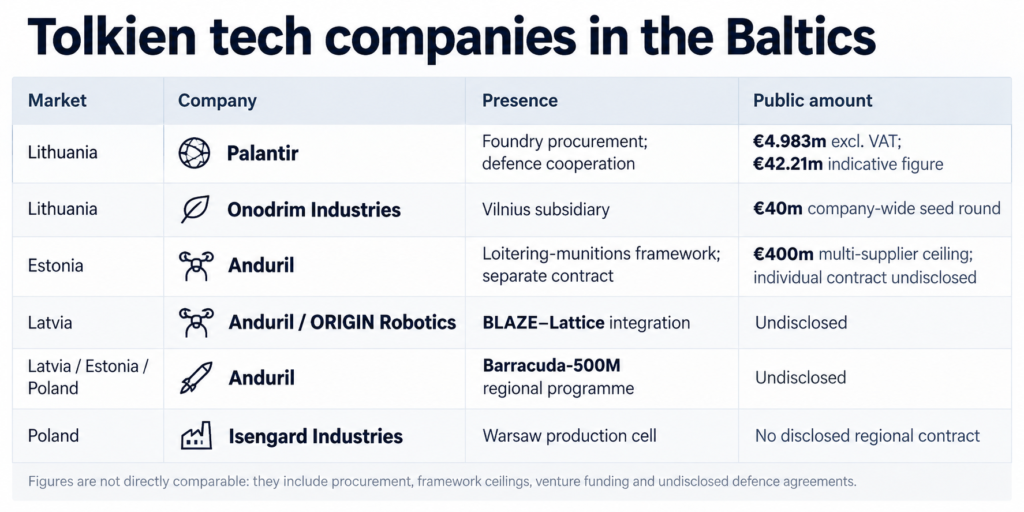
The figures show why a single price cannot be attached to this emerging network. Some activity is already reflected in public procurement, while other relationships remain at the stage of framework agreements, integration work, production plans or undisclosed defence contracts.
The more relevant signal is the shift from branding and corporate culture to physical presence. Companies from the same broader defence-tech ecosystem are now appearing in Baltic procurement registers, defence ministries, local subsidiaries, testing programmes and nearby production facilities.
For the region, that transition is already measurable.