Baltic Trade and Services in Q1 2026: What Drove Latvia, Lithuania and Estonia
The three Baltic economies entered 2026 with a common external pressure: goods balances remained weak, while services provided the main offset.
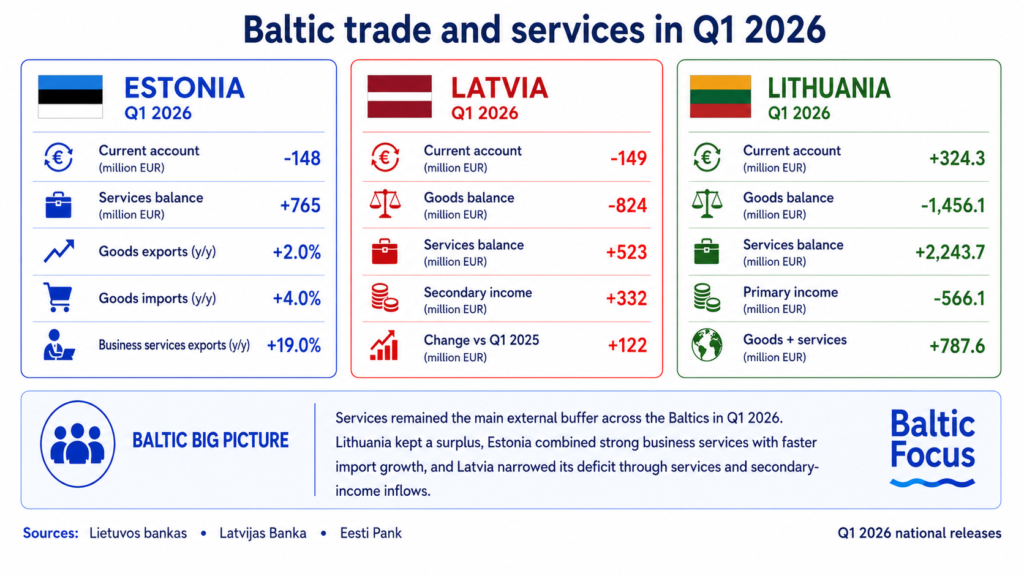
The three Baltic economies entered 2026 with a common external pressure: goods balances remained weak, while services provided the main offset.
The similarities, however, end there.
Lithuania’s services surplus was large enough to cover its goods deficit completely, although much of that cushion was absorbed by income paid abroad. Estonia combined strong growth in business services with faster growth in goods imports. Latvia’s external position improved, but the improvement came from services and secondary-income inflows rather than from a stronger goods balance.
The current-account results — a €324.3 million surplus in Lithuania and deficits of around €149 million in both Latvia and Estonia — were therefore the outcome, not the main economic story.
Lithuania: services covered the goods gap — and more
Lithuania recorded the strongest Baltic current-account result in the first quarter of 2026, with a surplus of €324.3 million.
The country ran a €1,456.1 million goods deficit, but this was more than offset by a €2,243.7 million services surplus. Goods and services together therefore produced a positive balance of €787.6 million.
A €566.1 million primary-income deficit absorbed most of that cushion. These outflows include income attributed to foreign investors and other cross-border income payments. They are not necessarily evidence of economic weakness: they also reflect the scale of foreign ownership and profitable international investment in Lithuania. But they materially reduce the domestic external surplus generated by services.
A further €102.8 million secondary-income surplus brought the current-account result to €324.3 million.
DATA CARD — LITHUANIA | Q1 2026
Current account
+€324.3m
Goods balance
−€1,456.1m
Services balance
+€2,243.7m
Primary-income balance
−€566.1m
Secondary-income balance
+€102.8m
Lithuania generated the largest services cushion in the region. Its main external pressure was not weak services performance, but the combination of a large goods deficit and substantial income paid abroad.
Latvia: a smaller external gap, but no improvement in goods trade
Latvia recorded a €149 million current-account deficit in the first quarter of 2026, compared with €271 million a year earlier.
The improvement did not come from merchandise trade. Latvia’s goods deficit widened from €662 million to €824 million.
The services surplus, by contrast, increased from €357 million to €523 million, offsetting almost two-thirds of the Q1 2026 goods deficit. Secondary-income inflows also rose sharply, from €174 million to €332 million.
The primary-income deficit widened from €140 million to €179 million. Overall, the larger services surplus and stronger secondary-income inflows more than offset the deterioration in goods and primary income, explaining essentially all of the €122 million year-on-year improvement in the current account.
DATA CARD — LATVIA | Q1 2026
Current account
−€149m
Change from Q1 2025
Improved by €122m
Goods balance
−€824m
Services balance
+€523m
Secondary-income balance
+€332m
Monthly data for April suggest that the mixed pattern continued beyond the first quarter.
Latvian goods exports rose strongly in April, but part of the increase was supported by volatile mineral-product re-exports and price effects. Imports also increased as domestic demand and investment strengthened.
Services exports were up 8.2% year on year in January–April, but April alone showed a 4.9% decline. Transport services remained the clearest drag, falling 11.3% year on year in April.
Latvia’s external position is therefore improving, but the recovery is not yet clearly export-led. Services and secondary-income flows are compensating for a wider goods deficit, while volatile re-exports and weak transport services continue to blur the underlying trend.
Estonia: business services strengthened as import demand increased
Estonia recorded a €148 million current-account deficit in the first quarter of 2026.
Its services sector continued to perform strongly. Services exports reached €3.253 billion, while imports stood at €2.489 billion, producing a surplus of €765 million.
Business services were the clearest growth engine, with exports rising 19% year on year. Total services exports increased by 4%, while services imports were broadly unchanged.
Goods trade moved in the opposite direction. Goods exports grew by 2%, while imports increased by 4%. Stronger imports reflected a combination of machinery and equipment purchases, defence-related imports and recovering domestic demand.
DATA CARD — ESTONIA | Q1 2026
Current account
−€148m
Services balance
+€765m
Goods exports
+2% year on year
Goods imports
+4% year on year
Business-services exports
+19% year on year
The goods balance and other cross-border income flows together absorbed more than Estonia’s services cushion. The first-quarter figures therefore show two developments at once: a competitive and expanding business-services sector, and an economy whose recovery and investment needs were increasing demand for imports.
The deficit itself is not automatically a sign of weakness. Its significance depends on whether higher imports are building future productive capacity or primarily supporting consumption. The Q1 figures point to a mixture of both, including machinery, equipment and defence-related purchases.
One region, three external-sector stories
Services were the main stabilising force across the Baltic economies in early 2026, but they supported three different structures.
In Lithuania, the services surplus fully covered the goods deficit, but a large part of the remaining cushion was absorbed by income paid abroad. Lithuania’s external position therefore depends not only on maintaining strong services exports, but also on the scale and timing of returns flowing to foreign investors.
In Estonia, business services continued to expand, while import growth reflected both recovering demand and investment-related purchases. The key question is whether today’s import-intensive recovery translates into stronger productive and export capacity later.
In Latvia, the current-account deficit narrowed, but the improvement was not driven by goods trade. Services and secondary-income inflows compensated for a wider merchandise deficit, while transport remained weak and headline export growth was partly affected by volatile re-exports.
The Baltic signal is therefore not simply that the region is becoming more dependent on services. It is that services are performing different economic functions in each country: generating a large export cushion in Lithuania, supporting an import-intensive recovery in Estonia, and compensating for persistent goods-trade weakness in Latvia.
For investors and businesses, that distinction matters more than the headline current-account balance. Two countries can report almost identical deficits while facing very different pressures — and very different paths back to a stronger external position.
Sources: Lietuvos bankas, Balance of Payments of the Republic of Lithuania, Q1 2026; Latvijas Banka, quarterly balance-of-payments tables, updated 16 July 2026; Eesti Pank, Q1 2026 external-sector release; Latvian Ministry of Finance, macroeconomic forecast presentation, 30 June 2026.