Why the Baltics Export Shrimp: Inside Their Distant-Water Fishing Fleet
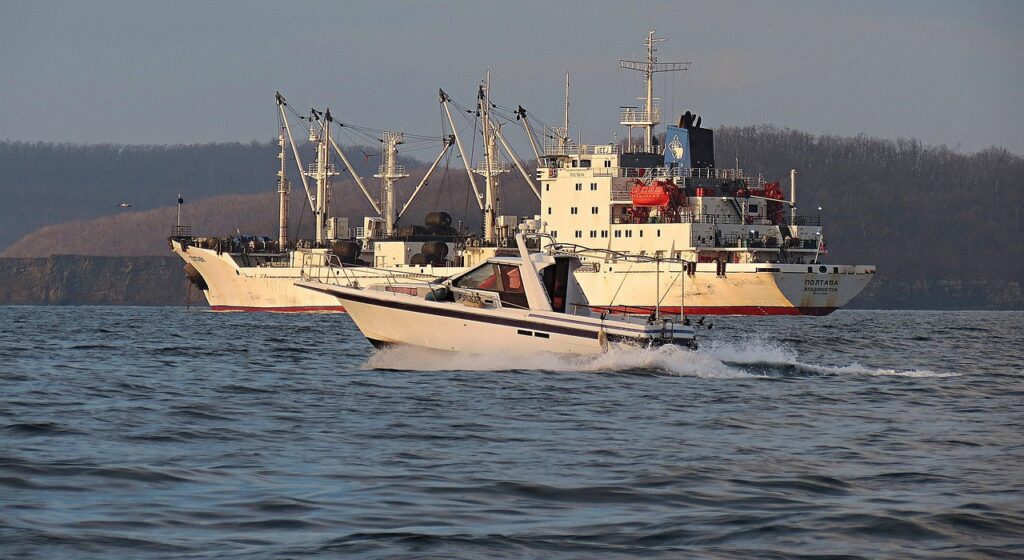
Shrimp alone accounted for more than 12% of Estonia’s fish and seafood export volume in 2025. According to Statistics Estonia, the country exported 9,406 tonnes of shrimp.
For a country on the Baltic Sea, that raises an obvious question: where does such a substantial shrimp trade come from?
The answer lies far beyond the Baltic. Estonia retains a small distant-water fishing fleet operating in northern waters. And once the same statistics are examined for Latvia and Lithuania, a broader pattern emerges: the fish exports and national catch statistics of all three Baltic states contain substantial volumes of ocean species and crustaceans caught thousands of kilometres from the Baltic Sea.
Estonia exported 74,648 tonnes of fish and fish products of Estonian origin in 2025. Frozen fish remained the largest category, at 45,958 tonnes. Baltic herring accounted for 53.2% of that volume and sprat for another 31.9%.
Shrimp was different. Estonia exported 9,406 tonnes, with almost a third going to China and Iceland the next-largest destination. China became Estonia’s fifth-largest market for fish products in 2025, largely because of shrimp exports.
The shrimp appears in Estonia’s national export statistics even though the fishery behind it operates far outside the Baltic Sea and, in practical terms, never enters it.
The fleet behind the statistics
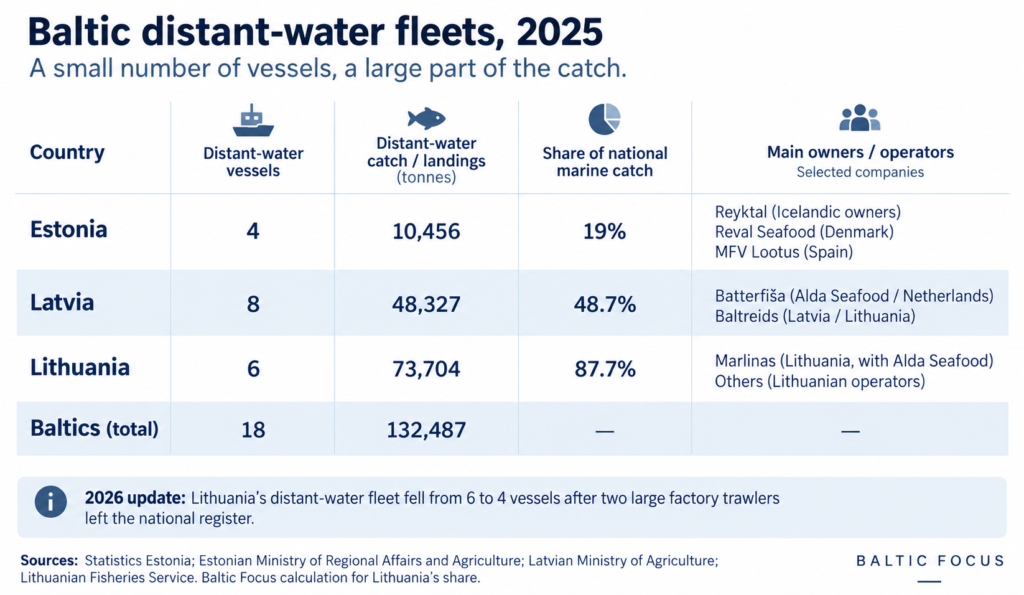
Estonia had only four vessels in its distant-water segment in 2025. Together they landed 10,456 tonnes, equivalent to 19% of the country’s commercial marine landings. Despite their small number, these vessels accounted for 61% of the gross tonnage of Estonia’s fishing fleet.
Northern prawn from the Barents Sea accounted for around 65% of the distant-water segment’s catch. The fleet also operates in other North Atlantic and Arctic fishing grounds and targets species including Greenland halibut and cod.
The export and catch figures should not be read as the same physical flow. The 9,406 tonnes of shrimp exported by Estonia cannot simply be equated with the 10,456 tonnes landed by the distant-water fleet. Fish can be landed abroad, processed elsewhere, stored or sold through different commercial channels.
But the two sets of official statistics describe the same broader economic structure: Estonia has a substantial shrimp export business, while its national fleet includes a small ocean-going segment whose main activities include northern-prawn fishing far beyond the Baltic.
Latvia and Lithuania show the same pattern, but on a considerably larger scale.
| 2025 | Distant-water vessels | Distant-water catch / landings | Share of national marine catch |
|---|---|---|---|
| Estonia | 4 | 10,456 t | 19% |
| Latvia | 8 | 48,327 t | 48.7% |
| Lithuania | 6 | 73,704 t | 87.7%* |
*Calculated from 73,704 tonnes caught in distant waters and 10,375 tonnes caught in the Baltic Sea, including coastal fishing.
Sources: Statistics Estonia; Estonian Ministry of Regional Affairs and Agriculture; Latvian Ministry of Agriculture; Lithuanian Fisheries Service. Baltic Focus calculation for Lithuania’s share.
The Lithuanian figure is particularly striking. In 2025, almost 88% of Lithuania’s marine catch came from distant waters, while only around 12% came from the Baltic Sea and coastal fisheries.
Together, the three distant-water segments produced roughly 132,500 tonnes in 2025.
Latvia: almost half the catch comes from distant waters
Latvia had eight vessels registered in its distant-water segment at the end of 2025. They represented only 1.2% of the fishing fleet by vessel count, but 78.7% of its gross tonnage.
Their catch reached 48,327 tonnes, or 48.7% of Latvia’s total catch.
Latvian vessels operated in NEAFC fishing areas and off Mauritania, targeting species including horse mackerel, mackerel, sardinella and northern prawn.
Unlike in Estonia, the connection with exports is stated directly in Latvian official statistics. Latvia exported 97,900 tonnes of fish products excluding canned products in 2025, of which the Agriculture Ministry attributes 48,200 tonnes to chilled and frozen products from Latvian distant-water fishing vessels.
In volume terms, the distant-water segment therefore accounts for roughly half of both Latvia’s national catch and its non-canned fish exports.
For Latvia, this is not a small residual part of a predominantly Baltic fishing industry. In terms of catch volume, distant waters and the Baltic Sea are almost equal components of the sector.
Lithuania: most of the fish is caught outside the Baltic
Lithuania shows an even stronger contrast.
Lithuanian vessels caught 10,375 tonnes in the Baltic Sea and coastal waters in 2025. Sprat accounted for 7,093 tonnes and Baltic herring for another 3,115 tonnes.
The country’s distant-water fleet caught 73,704 tonnes in the same year.
That means around 87.7% of Lithuania’s marine catch came from outside the Baltic Sea.
The largest volume came from Mauritanian waters, where Lithuanian vessels reported 37,357 tonnes in 2025. Another 14,076 tonnes came from the South Pacific, while western EU and UK waters added 14,988 tonnes, largely blue whiting. Lithuanian vessels also worked in NEAFC waters, around Svalbard and Greenland.
Northern prawn remains part of this system. During the first half of 2026, three Lithuanian vessels reported 3,657 tonnes of northern prawn from NEAFC and Svalbard fishing grounds.
The contrast with the domestic Baltic fishery is therefore substantial. In 2025, Lithuania’s distant-water catch was more than seven times its catch from the Baltic Sea.
The Lithuanian fleet has already changed
The 2025 figures do not describe Lithuania’s current distant-water fleet at the same scale.
At the beginning of 2026, Lithuania had six distant-water vessels with a combined gross tonnage of 32,671 GT. By 1 July, the segment had fallen to four vessels and 17,141 GT.
Two large factory trawlers, Ieva Simonaitytė and Simonas Daukantas, left the Lithuanian register in June. Oman-based Rawanq subsequently announced that it had acquired the vessels. They were renamed Al Tidra and Al Asifa, transferred to the Omani flag and sent to Mauritania to continue fishing.
The 73,704 tonnes recorded in Lithuania’s 2025 statistics therefore reflect a fleet that has since become substantially smaller.
Baltic flags, international capital
The national statistics also require another qualification. An Estonian, Latvian or Lithuanian fishing vessel in official data does not necessarily mean locally controlled capital.
In Estonia, Reyktal, one of the main distant-water operators, has three Icelandic corporate shareholders. According to the Estonian Business Register, Icelandic businessman Ottar Yngvason is listed as a beneficial owner. Reval Seafood combines Reyktal ownership with Denmark’s Ocean Prawns, while MFV Lootus is owned by Spain’s Valiela S.A.U.
Latvia has a more mixed structure. Batterfiša, operator of the freezer trawler Dorado II, is jointly owned by Alda Seafood and the Dutch PP Group. Alda also owns 25% of Lithuania’s Marlinas, a company operating specialised shrimp vessels.
Other operators remain more closely tied to Baltic capital. Latvia’s Baltreids, for example, has Latvian and Lithuanian shareholders.
The point is not that the fleets are somehow less Estonian, Latvian or Lithuanian statistically. The vessels operate under their respective national flags and their activity enters national fisheries data. But economically, part of the industry is embedded in larger Nordic and European fishing groups.
Why the fleet is “invisible”
None of this is secret. Vessel capacity, catches and fishing areas appear in national and European statistics.
What is much less visible is the sector as a distinct part of the Baltic economies.
Public discussion of fisheries in Estonia, Latvia and Lithuania tends to centre on Baltic herring, sprat, cod, coastal fishermen and annual EU fishing quotas. Distant-water fleets usually enter the broader public view only when something exceptional happens.
Latvia provided a clear example in 2017, when Norwegian authorities detained the Latvian vessel Senator in a dispute over snow-crab fishing rights around Svalbard. The case developed into a prolonged legal and diplomatic conflict and temporarily put Latvia’s distant-water fishing business into the national spotlight.
Most of the time, however, the distant-water fleet remains inside aggregated catch and trade statistics rather than appearing as a separate part of the Baltic fishing economy.
Estonia’s 9,406 tonnes of shrimp exports make that structure visible. Latvia shows it more directly: distant-water vessels accounted for almost half of the country’s catch in 2025 and for 48,200 tonnes of its non-canned fish exports. In Lithuania, distant-water vessels caught 73,704 tonnes in 2025, compared with 10,375 tonnes in the Baltic Sea and coastal waters.
The commercial chains behind these figures differ by country and company. But the national statistics show the same basic structure: a significant part of the fishing economy recorded as Estonian, Latvian or Lithuanian is generated by a handful of vessels operating far beyond the Baltic Sea.