€630m IPF Deal Gives BasePoint Control of Credit24 Across the Baltics in August 2026
New York-based BasePoint Capital completed its acquisition of International Personal Finance, the UK consumer-finance group behind Credit24 and Creditea.
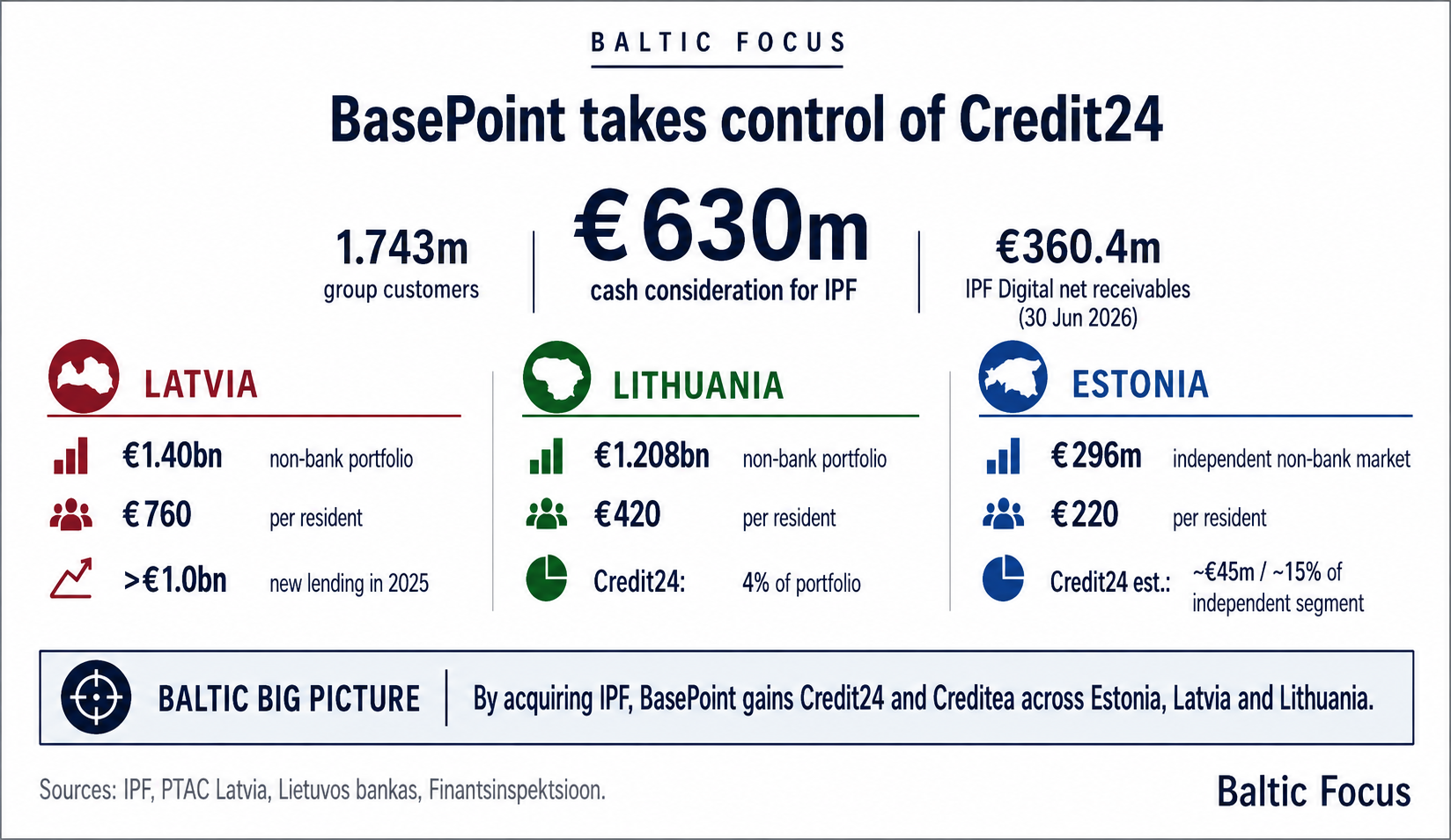
On 4 August 2026, New York-based BasePoint Capital completed its acquisition of International Personal Finance, the UK consumer-finance group behind Credit24 and Creditea.
The transaction gives BasePoint control of Credit24 and Creditea across Estonia, Latvia and Lithuania, alongside IPF’s larger businesses in Central Europe, Mexico and Australia.
For the Baltic market, the relevant asset is not one Latvian, Lithuanian or Estonian legal entity. It is a regional consumer-lending business with recognised brands, local licences, customer histories and operating companies in all three countries.
What BasePoint acquired
| Indicator | Deal parameters |
|---|---|
| Cash consideration at 235p per share | approximately €630 million (£543 million) |
| Target | International Personal Finance |
| Geographic reach | 9 markets |
| Group customers, 30 June 2026 | 1.743 million |
| IPF Digital customers, 30 June 2026 | 292,000 |
| IPF Digital net receivables, 30 June 2026 | €360.4 million (£310.6 million) |
| Baltic digital brands | Credit24 and Creditea |
| Baltic presence | Estonia, Latvia and Lithuania |
The cash consideration amounted to approximately €630 million (£543 million) at 235 pence per share. Eligible shareholders also received a 15 pence special dividend and retained the final dividend declared for 2025.
The operating figures in the table are taken from IPF’s results for the six months to 30 June 2026, the company’s final reporting period before the acquisition became effective.
Credit24 and Creditea are IPF’s digital brands in the Baltic states. The wider group also operates other consumer-finance brands, most notably Provident, in its other markets.
IPF Digital, which includes the Baltic operations, had 292,000 customers at the end of June 2026. Its net receivables increased from €337.7 million (£294.7 million) at the end of 2025 to €360.4 million (£310.6 million) by 30 June 2026. The euro equivalents use the applicable ECB reference rates on the respective reporting dates.
IPF does not disclose a separate consolidated Baltic portfolio. It is therefore not possible to calculate precisely how much of the digital loan book belongs to Estonia, Latvia and Lithuania.
National supervisory data nevertheless show that Credit24 is an established participant rather than a marginal regional brand. Company-level market shares are published in Lithuania and Estonia, but an equivalent Latvian breakdown was not available in the public market review examined for this article.
The asymmetry reflects differences in supervisory disclosure. Latvia’s Consumer Rights Protection Centre publishes detailed market totals and product categories but not the same company-level portfolio ranking available from Lietuvos bankas and Estonia’s Finantsinspektsioon. This absence should not be interpreted as evidence that Credit24 is necessarily smaller or structured fundamentally differently in Latvia.
The Baltic non-bank credit market
The comparison uses 2025 data published by Latvia’s Consumer Rights Protection Centre, Lietuvos bankas and Estonia’s Finantsinspektsioon.
The national categories are not fully harmonised. Latvia reports licensed non-bank consumer lenders. Lithuania reports consumer-credit providers outside credit institutions. Estonia’s headline creditor market includes large bank-owned finance companies, so the independent segment must be separated before comparison.
| Indicator, 2025 | Latvia | Lithuania | Estonia |
| Relevant non-bank or independent creditor portfolio | €1.40 billion | €1.208 billion | €296 million |
| Approximate portfolio per resident | €760 | €420 | €220 |
| New lending during 2025 | more than €1.0 billion | €617 million | no comparable figure published |
| Credit24 share of portfolio | not publicly disclosed | 4% | 3% of the full creditor market |
| Market structure | largest independent non-bank market per resident | large mass-market consumer-credit sector | independent lenders beside dominant bank-owned finance companies |
Sources: Consumer Rights Protection Centre of Latvia; Lietuvos bankas; Finantsinspektsioon. Per-resident calculations use the latest available population estimates for 1 January 2026. National regulatory categories are not fully harmonised.
Latvia: the deepest independent non-bank market
Latvia’s licensed non-bank consumer-credit portfolio reached €1.4 billion at the end of 2025. It increased by €181.13 million, or 14.86%, during the year, while licensed lenders issued more than €1 billion in new credit.
Distance loans accounted for €550.04 million of new lending. Leasing, rental and other loans secured by vehicles or other assets accounted for a further €309.39 million. Both categories expanded by almost 32% compared with 2024.
The structure matters. Latvia’s non-bank sector is no longer adequately described as a collection of small short-term lenders. It includes unsecured digital credit, credit lines, leasing and other instalment and asset-backed products.
Relative to population, Latvia has the largest visible independent non-bank portfolio in the Baltic states.
The €1.4 billion figure still does not capture every household obligation outside banks. Instalment payments and debts to telecommunications companies, utilities, retailers and other service providers may sit outside licensed-lender statistics.
This creates a broader constraint for the banking market. A household may have limited bank debt while already carrying substantial monthly obligations elsewhere. Those payments reduce disposable income and can restrict eligibility for mortgages or cheaper bank credit.
Lithuania: similar scale, lower per resident
Lithuania’s non-bank consumer-credit portfolio reached approximately €1.208 billion in 2025, while new lending amounted to €617 million.
IPF Digital Lietuva accounted for approximately 4% of the portfolio and 7% of agreements.
Its higher share of agreements than of outstanding credit indicates a concentration in relatively small, mass-market consumer loans rather than large-ticket financing.
Lithuania’s market is close to Latvia’s in absolute size but serves a considerably larger population. Its portfolio per resident is therefore substantially lower.
Estonia: a smaller independent market
Estonia’s overall creditor portfolio was approximately €1.5 billion at the end of 2025, but most of it belonged to finance and leasing companies connected with banking groups.
Independent non-bank creditors held about €296 million. That is the figure that can be compared more reasonably with the Latvian and Lithuanian markets.
IPF Digital Estonia held 3% of the entire creditor portfolio and 5% of agreements. Applied to the supervisor’s rounded market total, this indicates a portfolio of approximately €45 million, equivalent to roughly 15% of the independent non-bank segment.
This is a Baltic Focus estimate based on rounded supervisory data, not a market share published directly by Finantsinspektsioon.
Who controls the buyer
BasePoint is a privately held US speciality-finance group. Commercial lending, loan origination and securitisation are conducted through BasePoint Capital, while BasePoint Advisors is an SEC-registered investment adviser serving private investment vehicles.
One of the central figures behind the buyer is Eric Schneider, BasePoint’s chief executive and controlling owner.
Schneider began his career at Morgan Stanley, where he became executive director and head of CLO trading. From 2011 to 2018, he worked at Omega Advisors, the hedge fund founded by Leon Cooperman, serving as co-head of structured-credit investments.
He then became co-managing member and portfolio manager at OCO Capital Partners before acquiring a controlling interest in BasePoint in January 2020 and becoming its chief executive.
His background matters to the transaction. BasePoint is not simply a corporate owner adding another consumer brand. Schneider comes from the part of institutional finance concerned with structuring, funding, monitoring and extracting returns from credit portfolios.
BasePoint specialises in financing and scaling credit assets. Its arrival therefore points to a more active growth strategy for Credit24 rather than passive ownership.
IPF chief executive Gerard Ryan described the transaction as the beginning of the company’s next chapter with BasePoint. The wording is corporate, but it supports a strategy of continuity and development rather than the break-up of the acquired platform.
Why the Baltic platform matters
BasePoint has not published a separate Baltic strategy, so the following remains a working hypothesis.
By acquiring IPF, BasePoint gains more than licences. Credit24 and Creditea already provide a functioning three-country platform with customers, repayment data, scoring systems and collection infrastructure.
That matters because BasePoint specialises in financing and scaling credit portfolios. Its ownership may allow the Baltic business to expand through stronger funding, larger or more flexible credit lines, repeat lending and more intensive use of the existing customer base.
The three markets also offer different operating conditions: Latvia has the largest independent non-bank portfolio per resident, Lithuania has a large mass-market consumer-credit sector, and Estonia has a smaller independent segment alongside strong bank-owned lenders.
The main question is no longer whether BasePoint will seek to expand Credit24’s Baltic business, but where that growth will be directed: towards unsecured digital credit and repeat borrowing, or towards larger instalment, leasing and asset-backed products that already account for a substantial share of Latvia’s non-bank market.
That choice will show how BasePoint intends to apply its structured-credit expertise — by increasing the turnover of existing consumer receivables or by building larger and more financeable loan portfolios across the three Baltic markets.
Sources: International Personal Finance; Consumer Rights Protection Centre of Latvia (PTAC); Lietuvos bankas; Finantsinspektsioon.
Primary source
International Personal Finance
US BasePoint Capital LLC Completes Purchase of UK-based global lender International Personal Finance PLC